


Podcast Studio Mar 10, 2026

Written by Aankuur Bhogia
Most podcasts don't fail because the ideas are bad. They fail because the production quietly works against the host.
An echoey room. A guest who ends up way quieter than you. Video that looks like a laptop webcam, because it is one.
None of that feels obvious while you're recording. It shows up the second someone hits play, or a clip lands on a feed and doesn't hold attention past three seconds.
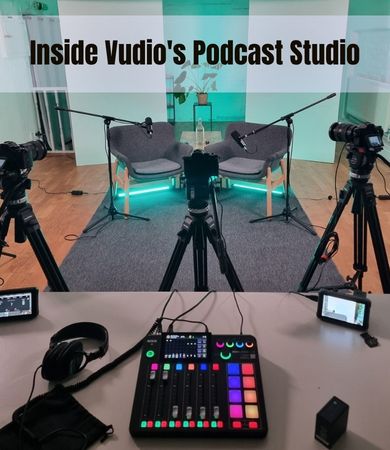
That's the gap our podcast studio is built to close. It sits alongside song recording, green screen and co-working, and it's set up for the parts of podcasting that are hardest to get right on your own. Clean audio, several camera angles, and footage you can cut into clips the same day. The our studios page walks through all four spaces.
One static camera is fine for a solo talking-head video. It falls apart the moment you add a guest.
Multi-cam catches every angle in sync. Host, guest, wide shot. Editing stops being a choice between the audio that sounds right and the shot that looks right.
It also changes what you can do afterwards. One camera gives you one thing: the episode. Multi-cam gives you the episode plus a stack of angles for shorts and quote clips.
And clips are usually what brings new listeners to the episode in the first place, not the episode itself.
If you've recorded at home, you already know the list.
A treated room and a proper mic setup deal with the audio before it happens. Multi-cam handles the visuals.
Having people around who do this daily handles the third problem, the one where the real work starts after you stop recording.
Guests clock production quality even when they don't have the words for it.
Walking into a real studio instead of someone's living room changes how seriously they take the conversation. It says this is a show worth showing up prepared for.
That matters more than most first-time hosts expect. A guest who takes the invite seriously gives you a better episode, and a better episode is the one that gets shared.
It also kills a whole category of friction. No asking someone to test their mic, troubleshoot a webcam, or hunt for a quiet room at their end. When a guest only has to show up, more of them say yes.
Recording is step one. Plenty of podcasters have a backlog of recorded-but-never-edited episodes sitting on a hard drive, because editing turned out to be the bigger time sink.
Session time here includes an editing and cutdown pass. Your episode goes from recorded to publishable without you learning new software or losing a weekend to trimming dead air.
That turnaround matters most if you're holding a weekly schedule. A recording that takes two hours to shoot and three weeks to edit isn't really a weekly show. It only looks like one from the outside.
Sessions are built around running a podcast, not just hitting record.
The point is that studio time turns into an episode that's actually live somewhere, not a file sitting on a drive.
We built this for hosts already putting in the work. Independent podcasters recording solo or with guests, founders and consultants using a show to build an audience, and creators who've outgrown a laptop mic in a closet. If that sounds like you, book a session and we'll check availability.