


Creator Tips Jun 16, 2026

Written by Aankuur Bhogia
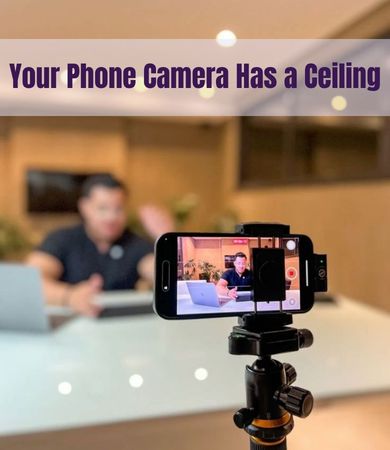
Phone cameras have got good enough that "shot on iPhone" is a real marketing line for actual films.
That's true, and slightly misleading for most creators. A good sensor solves one part of what makes content look professional, and it's rarely the part holding your videos back.
The ceiling almost never comes from resolution. It comes from what the camera can't control. The light on your face. The background behind you. How steady the shot is. And how consistent all of that stays from one video to the next.
None of this is an argument against phones. Modern ones handle resolution, stabilization and color well enough that plenty of professional content is shot entirely on them.
The sensor was never the bottleneck. What a phone can't do is add light that isn't in the room, remove a background that's already there, or keep conditions identical between a 9am shoot and a 6pm one.
Those are environment problems, not camera problems. No phone upgrade fixes an environment problem. It captures the same problem at a slightly higher resolution.
Film the same short clip in three spots in your home at three times of day, on nothing but your phone. Watch them back together.
In most cases, the difference in how professional each one looks has nothing to do with the phone. It's where the light was coming from and what was behind you.
The exercise works because it isolates the variable. The phone, the person and the content all stay the same. Whatever changes is coming from the room.
A green screen studio isn't about replacing your phone. Most creators still shoot on one, and that's fine. It's about controlling the two things a phone can never fix on its own: lighting and background. With both handled, every video looks like it belongs to the same channel.
Worth saying plainly, this isn't about hiding that a video was shot in a studio. Plenty of the most effective creator content is obviously produced, on purpose, because production value signals the content is worth someone's time. A controlled backdrop doesn't have to look invisible. It has to look intentional.
A controlled backdrop doesn't only look better, it makes editing far easier.
A clean key gives an editor room to add captions, swap in trending backgrounds or drop in b-roll without fighting a messy edge around you.
A cluttered background makes every one of those edits harder and usually worse. A lot of editing time on self-shot content goes into fixing problems a controlled shoot would have avoided.
Viewers register visual consistency even when they can't explain why a channel feels professional.
A recognizable look builds trust in a way one well-shot video can't. It's the difference between content that feels like a series and content that feels like a pile of one-off clips.
If your content has been capped by whatever room you happen to film in, that's a lighting and background problem, not a talent problem. Book a shoot and bring your phone. We'll handle the part it can't.